Tuesday, July 15, 2014

Garden Whimsy: Prayer Spiral


Sure you can pray anywhere. One does not need a special place but as Dorothy Frances Gurney said in her poem, God's Garden, "One is nearer God's Heart in a garden than anywhere else on Earth." I have had wonderful experiences in prayer labyrinths. I've gone with my bible study friends to local labyrinths but you never feel as totally at ease as you do in your own backyard. 


Spirals are such a part of God's natural creation and evolution. They are fluid, intriguing and even mathematical http://jwilson.coe.uga.edu/emat6680/parveen/fib_nature.htm. You find them in fern fiddle heads, sunflower seed formations, vine tendrils and pinecones. There is intense energy as well as overwhelming peace in the order and clarity of a spiral.

I planted mine with marigolds which are both warm and whimsical. My sister added a piece of rose quartz in the center which is sort of fun but possibly distracting. I find it natural to offer my petitions, tell God my troubles, ask my questions, sometimes even rail on my way inward. I stand before God in the center of the spiral. I find peace, quietude, silence in the center. When my soul is sufficiently quieted and unburdened I slowly leave the spiral, listening, waiting, in thanksgiving, receiving from God the answers and  the strength needed to face the day and its challenges. It takes great control not to stop for a weed or pinch off a spent flower. That must be left for another time, ironically  a time on my knees. A time to plant and a time to pluck up (Ecclesiastes 3:2b)

My prayer spiral was a part of my instant garden but it can be added anywhere at any time, in a garden, preferably where you're not competing with too much in the way of  ground covers. Choose plants that will stay put; that's why I choose annuals. I also have the deer to consider so I choose deer resistant plants, marigold, in this case
If you're installing the prayer spiral over sod or other ground cover completely cover the ground, plants and all with cardboard. Determine the center and begin laying out the walking portion of the spiral in wood chips or gravel. Fill in the correlating spiral with mulch or soil. You only need an inch or two. Plant with seeds or insert plants through the cardboard.
Prayer spirals add whimsy to the garden and also a place of deep spiritual connecting with God. God's creations are often whimsical. Why shouldn't we be as we come to him to share our joys and yes, our sorrows?


Monday, July 7, 2014

Garden Whimsy: Clothes Line Summer Shade


Seems like there is never enough shade when you want it in summer. In spring we seek out the warm sunshine to thaw our frozen toes and tan our winter white skin. As temperatures rise we hug the edges of shade, follow it through our gardens to weed and water in relative cool. This is when anything that can be called into double duty is desperately sought out, cajoled and subject to the whatever we can imagine. Wheelbarrows and buckets can be propped to shade vulnerable transplants from direct sunshine; canopies come in so handy for construction or involved garden projects. But when it comes to garden entertaining pull out all the stops and let your imagination run wild! Pull out some sawhorses and a sheet of plywood under the big tree. shabby chic table under the trees With a pretty white linen table cloth and some other items from the dining room you have shabby chic in the shade.
How about that clothes line and a fresh cotton sheet? Pull the picnic table underneath for casual dining. Go ahead and throw some cute clothes on the line to complete the theme.
Enjoy the garden all summer long. Be creative and keep cool.

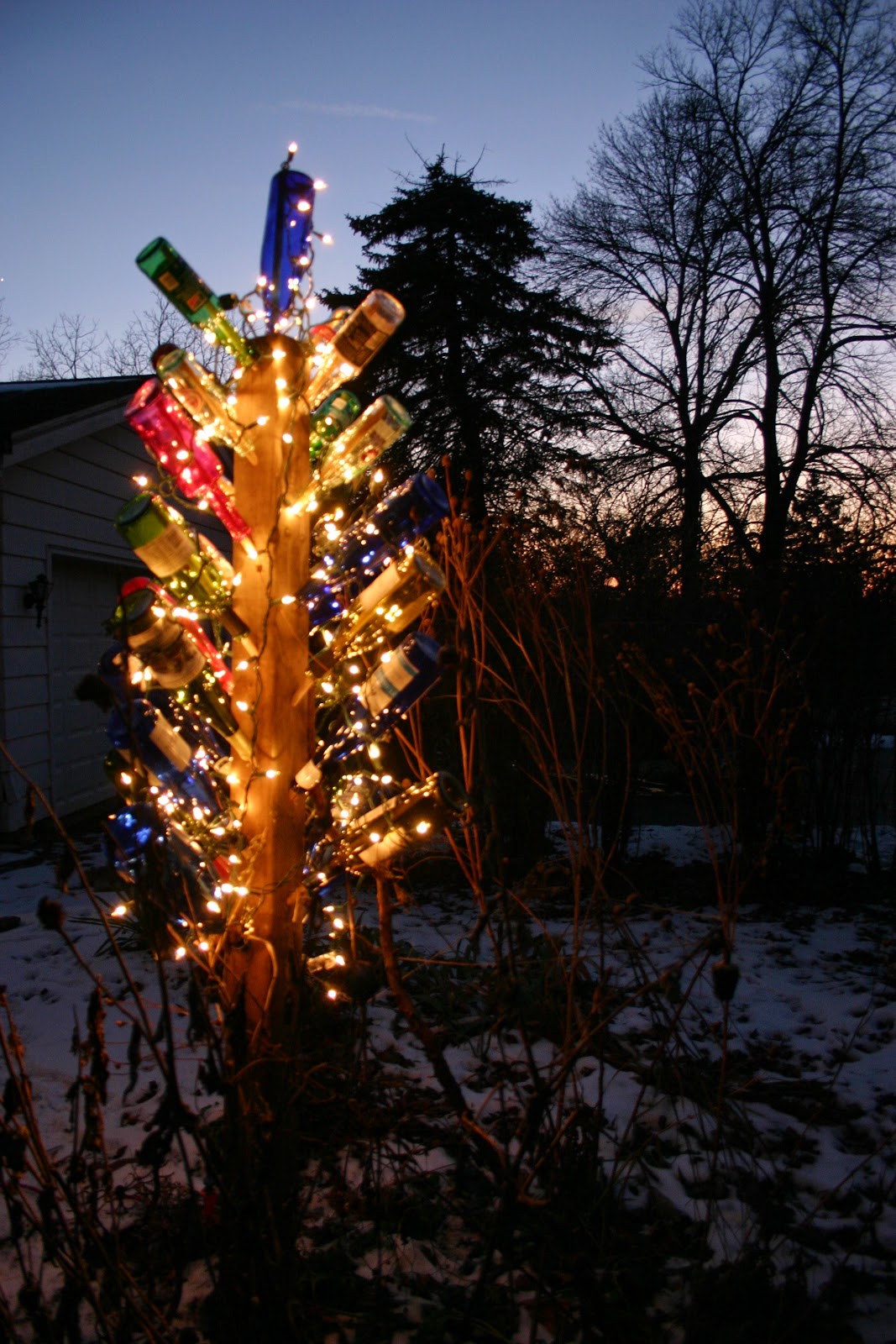
Garden Whimsy: the bottle tree


Hoo Doo, You do. Do what? My bottle tree has none of the pagan superstition hoo ha associated with it. It's just a colorful addition to the garden that catches the light and glows at night with lights showing each of the colorful bottles. There are no spirits in my bottles. Nothing spiritual in the least but boy can it lift my spirits especially when the sun shines on the many different color bottles or in mid winter when everything is twigs and dried leaves under layers of frozen snow but the bottle tree comes to life with strings Christmas lights woven in and around it.

Bottle trees originated in Europe thousands of years ago, when glass was first made. Evil sprints were thought to inhabit the bottles and the light of day was believed to kill them. The superstition spread through European countries and into Africa. African slaves were said to have brought the folklore with them to America. Fielder Rushing's History of the Bottle Tree also says cobalt blue is the most desirable color of bottle because of the Kobold Gnomes of Germany. I think the red ones are the best because they're harder to come by.
These days the garden ornamental trees far outnumber the Hoo Doo trees but I just had to be clear. I wouldn't want anyone misunderstanding my spiritual beliefs.  There's nothing spiritual about my bottle tree. Now my prayer spiral is another story altogether.


Whimsy: Garden Fairies


Once again, like my bottle tree, my fairy garden comes out of a sense of whimsy and fun.  There's nothing spiritual about my fairy garden except how close I feel to God when working in the garden. Fairies are a playful way to add mystery and enchantment to the garden. The imagination can roam and swirl about in the fairy garden. As the newest addition to the garden it is still young and sparse but next spring  I imagine it will have filled in and plants that like the conditions will thrive and spread to fill the space as other plants may struggle. I do my best to consider light and water needs of plants that I place there but often there are unforeseen aspects we cannot plan for.  

The fairy garden gets late afternoon light, as it is under a large crab apple tree. A path running  roughly north south alongside the garden to the west offers two paths that converge in the center of the garden. The first path has red monarda on the left with a group of white astilbe. A small juniper on the right shades a patch of simple interrupted  ferns, all bright green and billowy. I bought a new plant this year just for this garden, Amsonia tabernaemontana or blue star-willow which should quickly fill in this next section on the right if it gets enough moisture. The other path comes around the other side of the juniper and ferns. On the right are Black-eyed Susans and daisies, as this edge gets more sunlight. The daisies bloom early while the Black-eyed Susans bloom late. Further in, there is Jacob's ladders and yarrow.  As the paths join in the middle, the combined path narrows, giving the feeling of distance.

It's bordered on either side by pulmonaria and wild ginger and finally  thick swatches of sweet woodruff. Further off to the left are may apples and  small bleeding hearts which I hope will fill the corner while jack-in-the-pulpits dot the right. They have beautiful burgundy veined hoods. I have one red trillium which, if I'm lucky, will multiply. All of the plants in the fairy garden are plants the deer don't prefer. Though the word Fairy is derived from the ancient "faunoe o fatuoe" which, in the pagan mythology, indicated the faun's (deer) companions, creatures endowed with power of foretelling the future and ruling the human events, I don't  care for the deer dining on my garden. They are welcome to join me in the garden as long as they're just passing through or resting a while in the shade.

The path ends at the base of the crab apple which must have a diameter of at least 24 inches. I like to play with visitors, checking to see if they can actually see the fairy door, in the tree, saying not everyone can. Children of all ages love feeling blessed enough to be among the few who can see it. All mossy and adorned with semi precious rock, acorns, walnut shells and lavender flowers it sits in the deep dark most of the day. At night the whole garden glows with the light from three fairy lights. My son Andy made them from jars and glass bowls with solar lights inside. They're very magical indeed, and bring me such joy. They also protect the garden from enemy zombie gnomes, but that is for another day.


Thursday, July 3, 2014

Problem: Deer >>> Deterants


Deer me! Are the deer making too many trips to your all-you-can-eat salad bar? Continue serving all organic; just change the menu, lots of herbs and spices. Be cagey and put tempting treats out of reach. Learn to live with deer and you will enjoy seeing their graceful forms rather than stress out every time you see them.

There are so many lists of plants that deer don't prefer: lists of perennials, annuals, shrubs, and trees; lists by region put out by universities; and lists that give degree of resistance. I plant things almost exclusively off the lists in my backyard where, during certain seasons, it's practically a super highway for deer in and out of the woods. They'll take a nibble now and again but they don't linger. I don't have to worry.  The lists are extensive, too.
They include many plants with strong, spicy scents like monarda, mums, daisies, sweet woodruff, ferns and many herbs. Attracts Monarch Butterflies
Plants with milky white sap like  euphorbias,  milkweed,. balloon flower and vinca are not only unappetizing but can be poisonous to animals and people. Numerous plants used in medicines such as pulmonaria and digitalis are also poisonous to animals, as are most of the plants that have a common name ending in bane like fleabane, dogbane, and leopard's bane.
There are so many choices for your deer resistant garden.


What about all of the plants you adore that happen to be deer favorites too? Be smart about the locations you choose for these specimens.
Put them in protected areas, low traffic areas or even right out in gardens that the deer frequent as long as you protect them. People often invest great sums of money on sprays in hopes of making their prize hostas unappealing but this takes diligence and persistence. Any lapse in the applications, rain or watering can leave plants vulnerable. I prefer to have just a few of these tasty treats in my backyard gardens. I protect them within more substantial means.
Some I enclose in chicken wire if they're not front and center in the garden.
For those jewels that are focal points I use interesting, even whimsical structures such as bird cages,
large wire baskets,
or even decorative items that add a structural element to the garden.


For annuals hanging baskets are a great solution for keeping things out of reach and  off the radar of deer. It takes some planning and creativity to coexist peacefully with deer but it's worth it. It's so much less stressful and enjoyable when you're not at war in the garden. There are plenty of other challenges to keep us busy.


Tuesday, July 1, 2014

Master Gardener Program

Recently, in an attempt to insult me, my neighbors stood at our property line and proceeded to malign the Master Gardener Program. They were cutting out some scraggly honey suckle bushes that were  the only thing now that separated our quiet secret garden from their span of asphalt and the contents of their garage. I had planted a variety of shrubs there 15 years ago, but sadly, the former neighbors were unaware of the true border line between us when they helped us choose a site to plant. These new neighbors want a nice landscape but are not gardeners. They don't enjoy the process and they don't learn proper techniques. So, over the years she proceeded to prune out the good shrubs in favor of the fast growing invasive ones. I love gardening. I love the process, and all of the stages of the evolving landscape. I know that it's better to have the honey suckles removed because the berries just  became seedlings sprouting up everywhere but It's painful to have such a clear view of their gardening blunders.

The neighbor's comment was, "Anyone can take a class and become a Master Gardener," which implies that it is just a meaningless certificate that a person owns out of some sort of sense of superiority. On one hand the statement couldn't be further from the truth but on the other hand, yes, anyone is welcome to join this community of people who love gardening, gardens and learning. It would be wonderful if my neighbors would become Master Gardeners. The level one course is about 30 hours long with one exam, whcih counts towards the education hours required each year. In my opinion, the more important learning happens during the service hours out at approved gardens,  as new members work shoulder to shoulder with seasoned veterans. Discussion and advice are exchanged as beautiful gardens are maintained or produce is grown for local food pantries. It's a wonderful thing but you really have to love gardening to stick with something like this. It is not landscaping on a whim.

Now that the bushes are gone the neighbors have decided to plant a row of junipers which are about four feet tall. They are near our Hawthornes which means they are subject to contracting Juniper Hawthorne Rust, a disease that is passed back and forth between the two hosts. It causes gelatinous galls on junipers and spotted leavves on the Hawthornes. The disease cannot live without the two hosts, something you might consider if you cared about gardening and not just filling spaces. I really can't wait as long as it will take for the gaps between the bushes to fill in and for them to grow in height. I'm looking into the regulations on fences in our community. It's obviously more than just our differing attitudes towards gardening that keep us from geting along with our neighbors. We couldn't be more different and I don't care to see their SUV's or their 7 bags of garbage each week when I go out to the garden. Neither do I care to hear their negative opinions on what I care so deeply about.

Problem: Grass or weeds where you wanted your garden >>> transplant into the cardboard sections:

How to transplant into the cardboard sections:

Call me lazy but I've been using cardboard or newspaper in gardens for at least 15 years. It's a quick and easy way to stop whatever was growing in the spot from taking over your new planting area, whether its grass, weeds, or other ground cover. It becomes a decomposing weed barrier that lasts long enough to kill everything beneath it but then, like magic, becomes part of the soil. It has an added benefit of being great food for earthworms, which are wonderful aerators in you garden, loosening the soil for your more desirable plants' roots. It's also a very green way to recycle cardboard and green goes hand in hand with gardening. Overlap your cardboard pieces a little. You know those weeds are persistent and will fight their way through any crack or crevice.But once you have that nice smooth cardboard weed barrier which you spread with rich compost, how do you plant into the bed? Ideally one would wait until everything is decaying beneath the layers but who has that kind of patience.
If you're like me you want an instant garden so you plant your perennials shortly after the cardboard is layed and the mulch is spread . I would not recommend planting on top of the cardboard. It's usually too shallow and tends to dry out very quickly. Allow the cardboard to soften from the dampness of the soil beneath it or speed the process a little by watering the area.
Then with your spade it's "X marks the spot" for creating a little access point to the soil beneath. Use your spade or garden knife to cut through the cardboard in an x-shape,
folding back the cardboard to expose the soil and probably the undesirable plants you were hoping to eradicate.
Since you need to dig a hole for your plant anyway remove the grass, weeds, or other plants, making sure you don't leave any with access to the sun and open air. Fold points of cardboard under.
Plant your new plant, amending the soil if necessary and neaten up the mulch cover in the area. Repeat as needed.
Et voila, a no muss, no fuss instant garden. Spend your time and energy on the fun. Save some time to enjoy what you've done.