Thursday, May 21, 2015

Moments Later: Gardens in Spring are Amazing!


Despite the cool weather and low rainfall this spring, everything is up, growing and blooming! It always amazes me. No matter what's going on in your life, no matter how busy you've been or the sorrows or the joys, the ups and the downs, God is faithful in his creation. The perennials poke their noses up to sniff the air, check to see if it really is spring and then elbow their way through the barren soil, the crisp leaves, the chilly air. Then suddenly they're pushing and shoving for position. Watch out!
It won't be long before the tea 
room is overtaken and the tea 
pot needs to be rescued from 
this lovely floral runner.


The cracks and  brokenness
 no longer matter. The
 foliage and flowers are all 
anyone notice. They steal
the show.

April
May
Almost obscured now, this miniature gazebo protects a new hosta from bunnies and deer but it won't hold it for long. Then on it will go to the fairy garden for magical moments where it will be welcome in the miniature landscapes. 


 Jacob's Ladder, Astilbe, Hardy Geranium and Euphorbia jostle for space around stepping stones. 


 Sweet cups of polka dots don't last long before they burst forth and turn tea time into ice tea time on lawn chairs.


 Finally, I love to see this hosta at this intermediate state, as it seems to be expanding before my eyes. That stone will not see the light of day until fall once it becomes overshadowed by those enormous seersuckered  leaves. 

I love every minute of Spring. 


Thursday, May 14, 2015

Architectural Detail in the Garden: Hardscapes for your Softscape

difficult to see against the brown leaves
this Eiffel Tower will show up against
the green to come, later in Spring.
 Paris in April
Use your imagination. Let it take you out of your little backyard into the great big world. Or bring the world back home with you from places far away, places full of memories and meaning. From the Eiffel Tower to the Tower of London or the Leaning Tower of Pisa, miniature replicas can be found everywhere. Don't limit your search to the garden centers. Wooden or metal pieces can weather so nicely out in the elements.

 A Garden Gazebo
A darling place from which to view your garden. A darling place to view within your garden. Once again, let creativity be your guide as you look at items with a new eye for usefulness as a garden backdrop. It may be a piece of something larger or need a quick splash of paint but you'll know it when you see it. Train your eye to see things differently.
Broken and discarded or not-so-old "ancient ruins"? You decide. So many cement pieces are made to look like carved Italian marble or straight from the castles of England or Palace of Versailles. Even when they break, which happens now and again, find a new way to use them. When a planter is overflowing with luscious greenery who will know it no longer has a back and is cracked down the center? Or, rather, who will care? And then you have extra pieces to use as decorative stepping stones. You'll start breaking things on purpose!

 Cagey Coral Bells
How about that little plant the bunnies just won't stop nibbling on. It just can't catch a break, until you pop a cage over it and let it sing the glories of new growth. That tender new leaf, tasty as it may be, will get to see another day. And you'll get a chance to see it, too.


Song Birds in the Garden

Painted white and over-sized this one will stick out, even when the plants I put around it grow up and mature. Birds, squirrels, cats, foxes; wire, stone, metal, wood; animals are a natural part of the garden.
This one is in my vegetable garden. There's no reason why a vegetable garden can't be a fun and whimsical place, anything to get me in there to keep up with the weeds!
Leaky pipes? You may need your umbrella!
I don't know why but I just love sticking rusty old plumbing is the most ridiculous parts of my garden, especially the woods and farther reaches. This one gets protected from rain by May Apples or fairy umbrellas for those who are children at heart.


Anything that breaks up the mass of foliage and causes the eye to stop and see, really see the garden serves the purpose. It could be a rock... or something more interesting. Have fun with it.

Tuesday, May 12, 2015

Garden Math: Straw Bales + Mandala Configuration + Hugelkultur = Manbala Kultur

Straw Bale Gardening is all the Rage!
Hugelkultur or Hill Permaculture
Logs, branches and other heavier organic matter goes on the bottom
Hugelkultur, the garden practice that creates a permaculture garden in the form of a hill to enhance the organic matter for years, allows beneficial organisms to maintain aeration of soil and increases the planting area, has been practiced in Germany and other European gardens for hundreds of years. It was further developed by Sepp Holzer, an Austrian permaculture expert and others. It is becoming widely popular in backyard gardens all over the world. I, of course, can't be tied down to one thing so I've combined a number of garden techniques. See Permaculture Magazine 


The bales are placed over the organic matter and tied together if
you are using more than one together.
 Mandala Configuration
The Madala shape of the garden allows for the most garden planting area and ease of watering. Each branch of the mandala is individually a keyhole garden, which gives access to the whole planting area from the path that goes to the center of the individual branch. See Ecological Garden  
Once in place and watered, the bales would be very difficult to
 move so pick the location carefully. The amount of sunlight is a
major factor in choosing your location.


 Straw Bale Gardening
Straw Bale gardening gives you rich organic matter, heat which is needed early in the Spring to get a head start in the northern planting zones, protection from soil that may be carrying disease such as Bacterial Wilt and Early Blight that ruin tomatoes each year and besides, they're just plain fun! See Straw Bale Gardens and Bonnie plants


I recommend you start early in Spring or even in Fall. I purchased my bales from a local farmer I found on craigslist.com. I collected logs, branches and plant matter from our woods and gardens to assemble my hugelkultur bases in the mandala shape. The bales need to be conditioned for up to 2 weeks. This involves adding a fertilizer which is high in nitrogen to start the decomposition stage inside the bales. I tied 2 bales together for each of my sections to give me more planting space. 


 Seeds can be sown directly into the bales. I put in a small amount of potting mix to hold the seeds but it may not have been necessary. I tried some seeds without the potting mix a few days ago and am waiting to  see how that goes.

At first, straw bales require a more constant watering schedule but hold moisture well, if that makes sense. The water goes to the bottom so the tops need to be watered everyday. I plan on installing a timer and irrigation system. Once the straw breaks down and becomes part of the permaculture, though, watering will be less of issue because all of that organic matter will hold water.
 Here, in Wisconsin, we're having a very cold, slow start to our planting season. It's almost the middle of May and we have a frost advisory for tonight. I'm covering the newly sprouted plants and keeping my plants I've started in pots, in the little greenhouse unit 
H
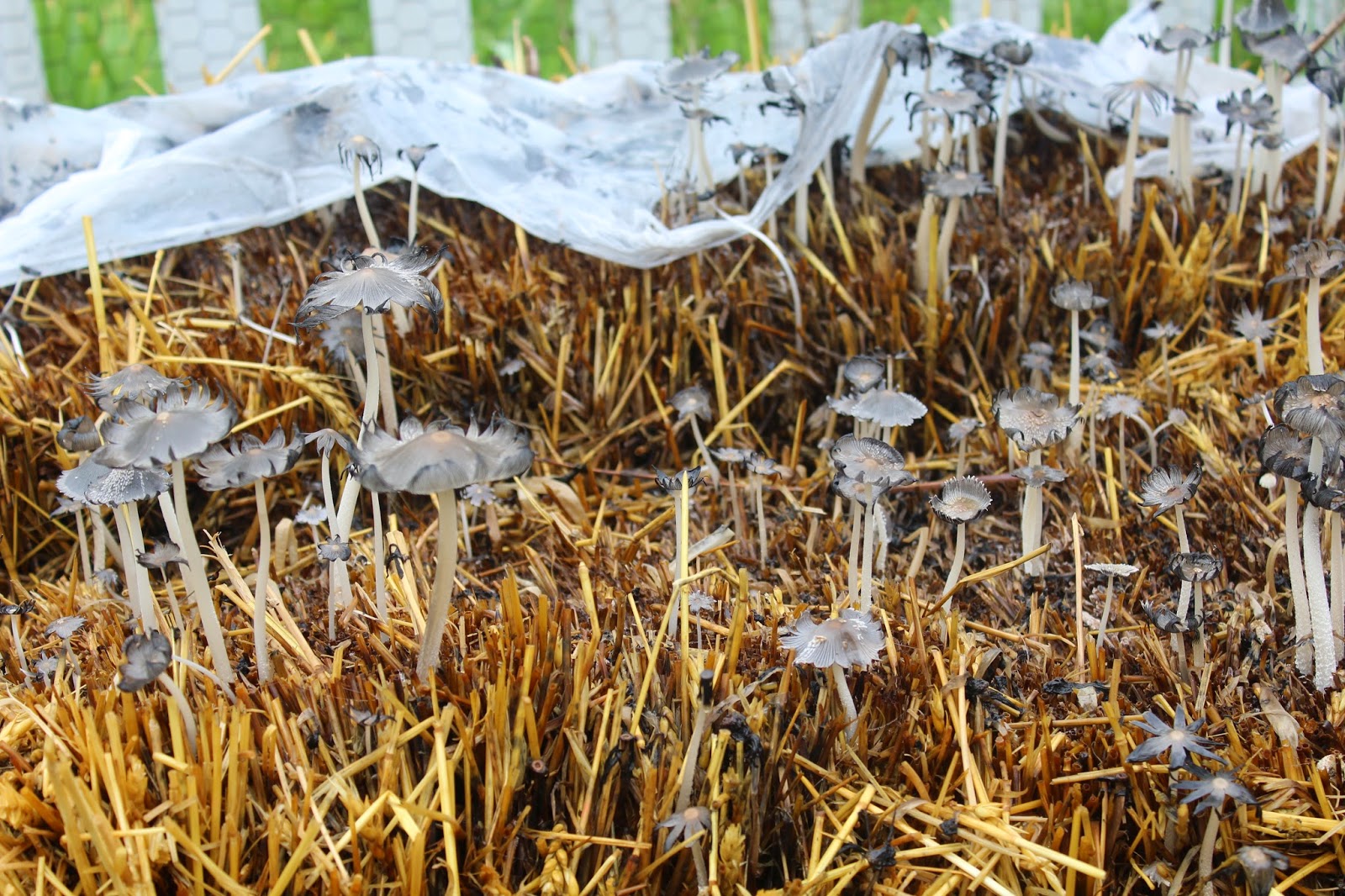
 In the meantime inky cap mushrooms help break down the straw  


I can't wait for my ManBala Hugelkultur garden to be full and growing!
Happy Spring planting!

Thursday, November 6, 2014

Garden Detente: Cage Them for Their Own Protection

Reds and Golds

Brilliant Yellows

Orange and Gold Canopy

Gorgeous Fall Spectrum of Color
Underneath the breathtaking canopy of reds, golds, and oranges the nervous frenzy is mounting. The squirrels start it with their frantic hiding of nuts in so many odd places, half of which they'll never find again.   This gets the other animals worked up. Pretty soon the compost bin has been ransacked; the mice have begun taking up lodging in the garage, storing the neighbors birdseed in your gardening boot and all animals begin to eat voraciously of anything they can find. Deer eat the last leaves off of low shrubs before they can even hit the ground and once the leaves are gone the tender  branches are also fair game.They're fattening up for the coming winter. Bucks rarely come out in  plain view in our yard, only in autumn and when winter is at its absolute coldest. You don't get to be a big old buck by being careless but when you're hungry you're hungry. They can eat a lot.

So, lock up your shrubs for their own safety. Roll out the fencing, the chicken wire, whatever you've got. It's got to be metal, though. Plastic is no match for those voracious eaters. For years they wouldn't let a few of my shrubs get any taller than a few feet and that was probably only because the snow bank was protecting that much.


 I've been slipping a tube of chicken wire over newly planted shrubs as soon as I put them in the ground. In fall I need to remember to check to make sure they haven't outgrown their armor.


Last year, in one area, where I've put shrubs close together, I unrolled 20 feet of six foot high fencing and enclosed the whole area. Low and behold the shrubs I thought weren't growing because of the amount of shade they were receiving actually grew and looked full and healthy.


 I was so satisfied with that solution that I did the same with a roll of four foot high chicken wire around another section this fall. I'll take the fences down when the coast is clear and tender buds are safe.


So now I'm out of chicken wire on hand and am reaching for anything to protect my taller shrubs, my accent shrubs and anything that is normally fair game during the cold winter months.


Now, I'm not heartless. I certainly don't want deer to starve. I offer up all the buckthorns, honeysuckles and volunteer shrubs and trees that have popped up in inconvenient places. They can have those. Enjoy! Just stay away from my Euonymous, my Ninebarks, my Red Twig Dogwoods, my new seedlings, and  even my Arborvitae. Yes, they even eat those in the winter months. That's why I've locked them up out of reach until the warm breezes and sweet smells bring us all out of our dens in spring.

Thursday, September 25, 2014

Garden Detente - Simplify


"All the great things are simple...  " ~Winston Churchill.
The garden simplifies. Ever notice how certain plants, shrubs or trees do well in your garden while others do not? As one species withers, is pruned back by animals, or fries in the sun others fill in to take its place. Our friendships can be like that, our careers, our interests. We often try to force the issue in the garden as in our daily lives. In an effort to keep that water loving ligularia from wilting under the long branching arms of your flowering crab you water and water until for a few days something keeps you from getting to it and inevitably it dies. But in its place you find the epimedium has filled in and is thriving.  It's sad but its a relief not to have to force nature.
Gardens have a way of taking care of themselves
that way. This is not to say our gardens and lives wouldn't benefit from some pruning and weeding now and again. Gardens are tamed or else they're fields or forests. We've taken away natural predators and introduced non-native species just as we've done in our communities and homes when we form friendships that are not based on honesty or when we look the other way when we see something that should be stopped. There doesn't seem to be anything to stop us from doing exactly what we please these days.  Many plants and shrubs thrive and grow stronger with pruning.


Green is beautiful! There are so many shades and textures of green.  A pop of color amidst all that green really stands out. It's also nice when we can coordinate some colors or get a nice contrast going but when you look out at the garden and have every color in the rainbow and all their hues going at once it's like that kid in school who wore striped shirts with plaid pants or the old guy in the office who wears those wide, bold ties on even louder shirts, too much! The garden is supposed to be a peaceful place, not like a friend who just can't stop talking. I've been guilty of this, the overly colorful garden, not the too much talking, I mean.  Ok, maybe both! In a polite garden as in polite conversation one plant talks or blooms and then is quiet while another plants gets it's chance. In a larger garden two, maybe three conversations can be going on at once but above that it becomes a complete din and no one can hear even their own thoughts.


Wednesday, September 17, 2014

Garden Detente - Divide and Conquer

Julius Caesar is credited with having said, "Divide and Conquer" in reference to Rome's approach to breaking up larger armies into smaller units and defeating them individually rather than taking them on in total and risking defeat against an army of equal strength. I guess that doesn't apply here at all but it sounds good because it is dividing time! We've passed the worst of summer heat and in many parts of the country there is enough rain now to reinvigorate the garden for a couple months. Many perennials have overstepped their bounds and creeped, crawled, pushed and shoved their ways into areas we don't want them. They've invaded other territories, another war analogy. They've gotten too big for their britches and our borders. In midsummer we risk losing newly transplanted dividings to the heat but the nights are getting cooler and the plants are coming back to life!


Sure it's true that we may want to divide plants before they get out of hand, as well. It's a great way to repeat color in our landscape. It's also smart to fill in dead spots with something you know grows well in your garden. Some people I know just don't learn. They keep replacing that plant that died with the same thing in the same place. Sometimes we just can't have that plant there no matter how much we'd love it. Maybe it can't tolerate those conditions or the foot traffic or your pets or other pesky animals that are definitely not pets. Why not divide a plant whose habits and needs you know very well.

Plants that spread readily by sending out new roots are the best candidates for dividing. There are many ways to divide plants and many plants whose root structure lends itself to dividing much more than others. Dividing a plant means that you will be doing a combination of cutting into roots and separating or untangling the roots. This can be done while the plant remains in the soil or once the entire plant is removed from the soil. Each method has it's advantages. Cutting through the roots with a spade can be done while the plant is still in the ground. The rest of the plant remains undisturbed. Digging the entire plant out of the ground is done when you don't want to cause undue damage to the roots and you want to be more precise with the separating of crowns and roots. This is often done with hostas because once you can get a good look at the roots it is usually clear where you'll want to cut. Cutting can be done with a kitchen knife for precision. I like to use a serrated knife.
 I keep one handy on my potting bench.


There are plants that do not multiply but instead come back strong every year. They may have a main tap root that goes deep into the soil cannot be divided but often leaf or root cuttings can be taken to multiply these gems in your garden. These are often the plants that multiply by seed as well. Leave the soil around them loose and clear of too much mulch that would prevent the seeds from contact with the soil they need. But that's a whole different kind of math than what were concerned with here.

Once you've divided your plants get them in the ground right away or at least keep them moist. Don't wait too long to get them in the garden. Give them the best chance to establish new roots before the first frost hits.

I can't wait to get right at this but tonight I'll have to be satisfied with listing the plants that need dividing and listening to the owls in the woods. Huhuhuhuh hoo hoo hoo


Thursday, September 4, 2014

Find Peace in the Garden

Escape, find peace.

Had a bad day? a bad week? Got bad news? Did someone let you down? Did you do something stupid? Feeling disappointed? Find peace in the garden. Weed meticulously or weed like mad! Take on a major task you've put off or barely do a thing when your eyes are too blurred with tears to see.


It's quiet even when it's noisy outside. The earth and foliage absorb sound. They absorb your thoughts, as well.


You see miraculous things in the garden. Butterflies float as if suspended on wires. Spiders spin webs more intricate than the finest French lace, have it torn to shreds and rework it before your eyes. Hummingbirds defy gravity. It can rain when the sun is shining bright, resulting in an array of colors promising new tomorrows. And if that isn't enough the garden can renew your soul.

Yes, the garden is filled to the brim with grace. You know it is. You've seen it renew itself after damage, natural or man made. It can heal YOU, too. Time spent in the garden is a soothing balm. It's Jesus Christ himself, cleaning your wounds, hand on your shoulder, telling you it will be all right. When he was here, physically, he spent time in a garden.

So, sit in the garden. Take what you need of its inexhaustible peace, its unfathomable beauty,  intoxicating aromas. Watch its intricate workings, become a part of the cyclical ebb and flow, become one with God's creation. Feel your problems melt away like the spring thaw. Be at peace in the garden.